
Table of Contents
Understanding BDA DAS Verification Essentials
Imagine a fire breaking out in a large commercial building in Idaho Falls, where firefighters struggle to communicate due to weak radio signals inside. This scenario highlights the vital need for BDA DAS Verification, ensuring reliable in-building public safety communications. In southern Idaho and the Northwest, such verification prevents tragic communication failures during emergencies.
Bi-Directional Amplifiers (BDAs) and Distributed Antenna Systems (DAS) amplify public safety radio signals indoors, distributing coverage uniformly to eliminate dead zones in commercial and industrial structures. BDAs boost two-way radio transmissions bidirectionally, while DAS acts like a building’s nervous system, extending signals through multiple antennas. Emergency Responder Communications Enhancement Systems (ERCES) mandate this under NFPA 72 compliance, requiring in-building public safety radio testing to achieve uniform signal strength, such as a minimum of -95 dBm, often using grid patterns with donor antennas placed strategically.
Common challenges include signal attenuation in large facilities, like hospitals, where unverified systems risk delayed responses. Regulatory mandates from building codes demand public safety DAS compliance, including BDA compliance checks and DAS signal verification through field testing and certification. For instance, a verified DAS in an Idaho Falls hospital ensures clear communications for EMS teams, improving response times and safety.
Key terms at a glance:
- BDA: Boosts signals for first responders.
- DAS: Distributes coverage evenly.
- ERCES: Tests for NFPA 72 standards.
This guide covers fundamentals, verification processes, and advanced compliance strategies. To fully grasp verification, we first explore the core components of BDA and DAS systems.
With over 50 years in two-way radio systems, White Cloud Communications designs, installs, and tests bda system solutions tailored for regional needs. Our experts handle signal amplifier installation to meet stringent codes, offering peace of mind for building owners facing these essentials.
Core Fundamentals of BDA and DAS Systems
Bi-Directional Amplifiers (BDA) and Distributed Antenna Systems (DAS) form the backbone of in-building public safety radio coverage, ensuring first responders maintain clear communication in emergencies. These systems address signal challenges in large structures like hospitals and campuses in southern Idaho, where White Cloud Communications designs custom installations to eliminate dead zones. By boosting and distributing public safety frequencies, such as 700/800 MHz, BDA and DAS integrate seamlessly to achieve uniform coverage, preventing failures during critical operations.
Key Components and Design Principles
Think of a BDA as a signal megaphone that captures and amplifies external radio waves for indoor use. Its basic architecture includes a donor antenna mounted outside to receive public safety signals, a bi-directional amplifier that strengthens both uplink (from inside to outside) and downlink (external to internal) transmissions, and distribution networks like coaxial cables that route the boosted signal indoors. These elements work together to overcome building materials that block signals, such as concrete or metal, ensuring reliable propagation based on factors like structure size and layout.
DAS, on the other hand, acts like a web of indoor speakers, deploying multiple remote antennas to evenly spread signals across vast areas. Key components mirror BDA’s but expand with a head-end unit connecting to the donor source, signal splitters for multi-path distribution, and remote units with integrated amplifiers for localized boosting. Integration focuses on public safety frequencies, with design principles emphasizing site surveys to map signal loss and optimize antenna placement for 99% coverage uniformity.
White Cloud’s expertise shines in projects like a Twin Falls warehouse DAS installation, where custom designs accounted for high ceilings and machinery interference to deliver seamless in-building public safety radio testing results.
BDA and DAS often synergize in hybrid setups, with BDA providing the initial boost and DAS handling even distribution for complex buildings. The following table highlights their core elements:
BDA vs. DAS System Components Comparison
This table compares core elements of BDA and DAS to clarify their roles in in-building public safety communications.
| Component | BDA Function | DAS Function |
|---|---|---|
| Donor Antenna | Captures external public safety signals from outside the building. | Receives and distributes signals across multiple indoor points. |
| Amplifier | Bi-directional amplification for uplink and downlink signals. | Supports multi-frequency amplification for broader coverage. |
| Distribution Cables | Routes boosted signals via coaxial or fiber to indoor points with minimal loss. | Employs fiber optic or hybrid cabling for long-distance, low-attenuation signal splitting. |
| Coverage Metrics | Targets -95 dBm RSSI minimum with SINR above 10 dB for basic boosts in smaller areas. | Aims for 99% uniformity, monitoring RSSI and SINR across grids for large-scale reliability. |
Data sourced from NFPA 72 guidelines and White Cloud project specifications, with signal thresholds like BDA’s -95 dBm minimum coverage and DAS’s 99% uniformity goal. BDA suits simpler boosts in mid-sized facilities, while DAS excels in expansive structures requiring precise, multi-zone coverage–White Cloud recommends hybrids for Idaho campuses to balance cost and performance.
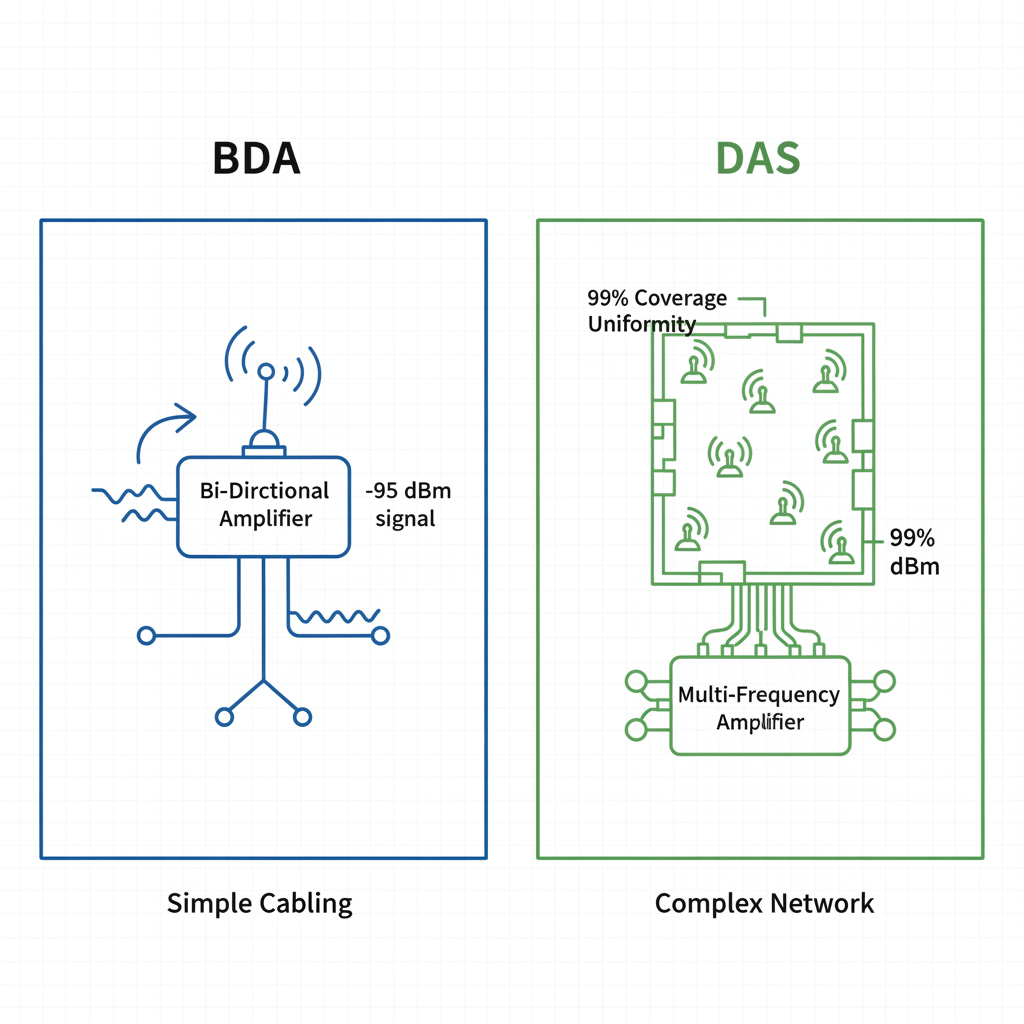
Comparison of BDA and DAS systems fundamentals
Regulatory Foundations for Verification
Verification of bda das system installations hinges on established standards to guarantee public safety efficacy. The National Fire Protection Association’s NFPA 72, particularly Chapter 24, mandates Emergency Responder Radio Coverage Enhancement Systems (ERCES) for new and renovated buildings, requiring systems to deliver at least 95% coverage with a minimum Received Signal Strength Indicator (RSSI) of -95 dBm and Signal-to-Interference-plus-Noise Ratio (SINR) of 10 dB or better. This standard addresses public safety DAS compliance by outlining design, installation, and testing protocols, including initial acceptance tests post-installation to confirm signal donation from donor antennas meets criteria like no more than 3 dB gain variation.
Complementing NFPA 72 is UL 2524, the Outline of Investigation for Emergency Communications Systems, which certifies BDA and DAS equipment for reliability under UL testing. It specifies performance in amplifying public safety bands without distortion, ensuring bi-directional functionality and automatic shutdown to prevent interference. For Idaho buildings, these align with International Fire Code (IFC) Section 510 and local amendments, enforcing BDA DAS Verification through grid testing on 20×20 ft patterns, as detailed in ERCES guides–techs measure RSSI at each point to verify uniformity and document compliance.
Common misconceptions arise around passive versus active systems; while passive DAS relies on natural signal splitting, active versions like BDA use amplification, both needing FCC licensing for operation. White Cloud handles these, including custom building antenna signal booster integrations compliant with narrowband rules. Initial checks involve spectrum analyzers for interference and donor site coordination, building trust in designs that prevent verification pitfalls. Ultimately, these foundations ensure systems support emergency responders, with White Cloud’s 24/7 support aiding ongoing compliance in southern Idaho facilities.
In-Depth Verification Processes for BDA DAS
Building on design basics, verification requires precise execution to ensure BDA DAS systems deliver reliable in-building public safety radio testing and meet life-safety standards. In southern Idaho, facilities like fire stations and hospitals depend on these processes to enhance emergency responder connectivity. White Cloud Communications applies proven methods, drawing from NFPA 72 and UL 2524 standards, to achieve uniform signal strength above -95 dBm, preventing coverage gaps during critical operations.
ERCES Grid Testing Procedures
ERCES grid testing forms the cornerstone of BDA DAS verification, creating a systematic approach to map signal coverage across entire buildings. This method divides the space into a 20×20 foot grid, measuring uplink and downlink signals at each intersection to confirm compliance with required thresholds. For optimal results, testing occurs post-installation and before AHJ approval, using calibrated tools to simulate real-world public safety radio usage.
The process unfolds in numbered steps:
- Site Preparation: Survey the building layout to establish the grid pattern, marking points with tape or digital mapping software. Ensure no obstructions interfere with measurements.
- Equipment Setup: Deploy spectrum analyzers, portable test radios, and calibrated antennas. Connect to the donor site for baseline signal analysis, verifying multi-band support as outlined in compliance checklists.
- Signal Measurement: At each grid point, transmit test signals using public safety frequencies. Record RSSI values, aiming for downlink coverage greater than -95 dBm and uplink sensitivity to match. Bda system specialists oversee calibration to avoid errors.
- Data Analysis: Compile readings into a signal heat map, identifying weak zones for adjustments like additional antennas.
- Reporting: Document findings with photos and metrics for certification submission.
In a White Cloud project at a Burley manufacturing plant, this grid approach ensured 97% coverage uniformity, integrating seamlessly with two-way radios for enhanced safety.
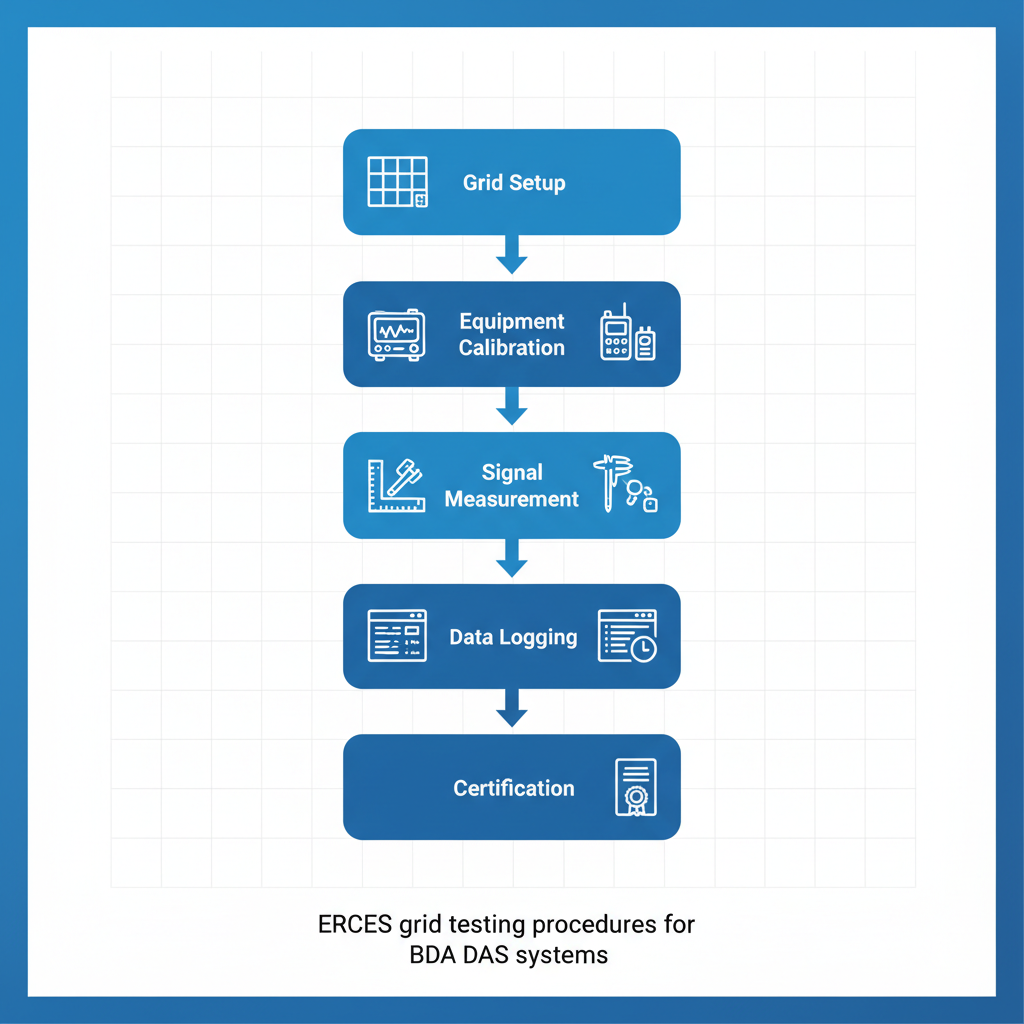
Step-by-step ERCES grid testing process for in-building wireless systems
The following table compares traditional and advanced ERCES grid methods, guiding selection for various building types based on NFPA 72 standards:
| Method | Traditional Testing | Advanced ERCES Grid |
|---|---|---|
| Equipment Used | Basic signal meters and walk-through tests | Grid-pattern analyzers, spectrum analyzers, calibrated antennas |
| Accuracy | Spot checks with potential gaps | Comprehensive 95-99% coverage mapping |
Traditional testing suits small structures but risks overlooking hidden dead zones, while advanced ERCES provides detailed insights, yielding higher ROI through avoided compliance fines. White Cloud employs these for Idaho projects, ensuring signal uniformity above 95 dBm.
Compliance Verification Methods
Compliance verification for BDA DAS systems involves field testing techniques, rigorous documentation, and ongoing monitoring to uphold public safety DAS compliance. These steps confirm integration with NFPA 72 alarm systems and address Idaho-specific building codes, such as those for critical infrastructure. Field teams conduct walkthroughs with portable radios to simulate emergency scenarios, measuring donor site signals and in-building propagation.
Key techniques include:
- Field Testing Protocols: Use spectrum analyzers for frequency-specific checks and DAS verification protocols to validate BDA amplification. Test for interference from building materials, ensuring signals penetrate walls without degradation.
- Certification Documentation: Compile test reports, as-built drawings, and AHJ submittals. Quote compliance checklists from industry standards to demonstrate multi-band efficacy, including P25 and LMR compatibility.
Common misconceptions arise around passive versus active systems; while passive DAS relies on natural signal splitting, active versions like BDA use amplification, both needing FCC licensing for operation. White Cloud handles these, including custom building antenna signal booster integrations compliant with narrowband rules. Initial checks involve spectrum analyzers for interference and donor site coordination, building trust in designs that prevent verification pitfalls. Ultimately, these foundations ensure systems support emergency responders, with White Cloud’s 24/7 support aiding ongoing compliance in southern Idaho facilities.
Common pitfalls involve improper calibration, leading to false positives, or neglecting post-modification re-testing. For instance, renovations in hospitals may require immediate re-verification to maintain coverage. Erces maintenance testing is essential annually or after changes, preventing downtime in facilities like Idaho Falls emergency centers.
White Cloud’s licensed services handle these for southern Idaho clients, providing certifications that streamline approvals and reduce liability. In one case, a fire station retrofit avoided re-testing delays through proactive donor analysis.
To further illustrate, consider this equipment comparison for basic versus advanced verification:
| Equipment Type | Basic Tools | Advanced Tools |
|---|---|---|
| Signal Measurement | Handheld meters, basic radios | Spectrum analyzers, automated grid scanners |
| Analysis Capabilities | Manual logging, spot readings | Real-time mapping, AI-driven gap detection |
Basic tools work for routine checks but lack precision in complex environments, whereas advanced options, favored by White Cloud for projects exceeding UL 2524 benchmarks, deliver comprehensive data for long-term reliability. This approach not only meets regulatory demands but also optimizes system performance, ensuring seamless two-way radio integration and robust emergency response.
Practical Steps for BDA DAS Implementation and Testing
Implementing and verifying BDA DAS systems requires meticulous planning and execution to ensure reliable public safety communications. Drawing from White Cloud Communications’ successful deployments in Garden City and Burley, Idaho, this section outlines essential steps for site surveys, pre-verification, field testing, and troubleshooting. These practices align with NFPA 72 Chapter 24 mandates, helping facilities achieve seamless in-building coverage for first responders.
Site Surveys and Pre-Verification Planning
Begin with thorough site surveys to map signal challenges and plan verification grids. Use tools like signal analyzers, spectrum scanners, and digital floor plans to identify dead zones in buildings such as warehouses or offices. For instance, in a Burley logistics facility, White Cloud teams conducted initial walkthroughs to pinpoint areas with multipath interference from metal shelving, ensuring comprehensive coverage before bda systems installation.
Create a pre-verification checklist to confirm prerequisites. Key items include verifying donor signal strength at the roof entry point, inspecting cable integrity for attenuation losses, and documenting antenna placements. Develop a grid-based testing layout, dividing the space into 20×20-foot zones for systematic coverage checks. Integrate ercs testing protocols early to prepare for ERCES-specific requirements like 95% signal strength across critical areas.
Anticipate common pitfalls, such as overlooking HVAC interference, which can distort readings. White Cloud recommends partnering with certified technicians for these surveys, often costing $1,500 to $5,000 depending on building size, to avoid costly rework. This phase addresses how to achieve public safety DAS compliance by establishing a solid foundation for subsequent testing.
The following table compares pre- versus post-install checks to streamline your process:
| Phase | Actions | Tools |
|---|---|---|
| Pre-Install | Site mapping, donor signal verification, cable routing planning | Signal analyzer, floor plan software, cable tester |
| Post-Install | Grid layout confirmation, initial signal baseline, integration testing | Spectrum scanner, logging app, multimeter |
These checks enhance efficiency, reducing verification time by up to 30% in Idaho projects.
Field Testing Execution and Troubleshooting
Execute field testing with a structured protocol to validate BDA DAS performance. Start by traversing the predefined grid, logging signal levels at each point using calibrated devices. For in-building public safety radio testing, measure RSSI and SINAD values to confirm compliance with IFC thresholds, typically aiming for -95 dBm or better. In Garden City’s healthcare installations, White Cloud technicians followed this by integrating paging systems and repeaters, ensuring unified coverage without dead spots.
Follow these step-by-step actions:
- Calibrate equipment on-site and confirm ambient conditions.
- Walk the grid methodically, recording data at knee height for realistic responder simulations.
- Log anomalies in real-time via mobile apps for immediate analysis.
- Test donor and distributed signals under load to simulate peak usage.
The provided reference on ERCES ercs testing BDA grid testing emphasizes recalibrating for multipath interference, a tip White Cloud applies to boost accuracy in reflective environments like hospitals.
Address troubleshooting proactively for low signals. Adjust amplifier gains or reposition antennas if coverage dips below 90%. Common issues include cable faults–resolved by continuity checks–or donor signal fluctuations, mitigated by backup antennas. For public safety DAS compliance, document all adjustments and retest affected zones. Re-certification is essential post-modifications, as NFPA 72 requires it to maintain UL2524 listings; costs for audits range from $2,000 for small sites to $10,000 for large complexes, factoring in technician time and reporting.
White Cloud’s 24/7 support handles these challenges, offering rapid response for Idaho clients. Integrate with existing repeaters by verifying interoperability during tests, enhancing overall system resilience.
The following table outlines testing frequency comparisons to inform maintenance planning:
| Building Type | Initial Testing | Annual Re-Verification |
|---|---|---|
| Commercial (e.g., Office) | Post-installation full grid. | Every 1-3 years or post-modification. |
| Critical (e.g., Hospital) | ERCES grid with 95% coverage check; see ercs testing for execution details. | Annually, plus after any changes. |
Per NFPA 72 and IFC requirements, critical facilities in Idaho demand stricter schedules; White Cloud tailors these for local codes, preventing compliance lapses and ensuring operational uptime. With these processes in place, facilities can transition to advanced considerations for long-term efficacy.
Advanced Topics in BDA DAS Maintenance and Compliance
Maintaining BDA DAS systems demands rigorous protocols to ensure uninterrupted public safety communications in Idaho’s demanding environments, such as mining sites and utility plants. White Cloud Communications leads with tailored strategies that integrate cutting-edge testing and compliance measures, preventing signal failures during critical operations. This section delves into re-certification essentials and technological integrations to support long-term reliability.
Re-Certification Protocols and Frequency
Re-certification of BDA DAS systems is vital for upholding BDA DAS Verification standards, particularly in facilities where signal integrity directly impacts emergency response. Annual routines, as mandated by NFPA 72, involve comprehensive grid testing to measure donor signal strength, amplifier performance, and in-building coverage. Post-modification triggers, like structural changes in a hospital or industrial upgrade, necessitate targeted re-verification to address potential disruptions. Advanced compliance strategies include multi-frequency load testing with specialized analyzers, ensuring systems meet evolving UL 2524 and fire code requirements through fire code radio signal testing.
White Cloud’s protocol for Idaho clients incorporates 24/7 monitoring, reducing downtime and costs associated with reactive repairs. For instance, during the Idaho Falls hospital upgrade, proactive re-testing identified and resolved coverage gaps before full occupancy, enhancing public safety DAS compliance.
The following table compares re-verification needs across key scenarios to aid strategic planning:
| Scenario | Trigger | Testing Scope |
|---|---|---|
| Annual Routine | Scheduled maintenance | Full Grid: Comprehensive ERCES check |
| Post-Modification | Building alterations | Full Grid: Targeted + overall verification |
These schedules underscore the cost-benefits of proactive maintenance, aligning with NFPA 72 annual requirements to minimize risks in high-stakes settings.
Integration with Emerging Technologies
Enhancing BDA DAS systems with emerging technologies ensures future-proofing for Idaho’s public safety infrastructure, from LMR standards to advanced networking. Integration with P25 and DMR radios improves interoperability, while GPS tracking units provide real-time asset location for first responders in remote mining operations. White Cloud’s extensive tower network of over 70 sites supports wide-area coverage, facilitating FCC narrowband compliance and seamless signal amplification.
Looking ahead, preparing for 5G public safety involves next-generation amplifiers with enhanced spectral efficiency, as seen in solutions from industry leaders. These upgrades address in-building public safety radio testing challenges by boosting capacity for voice, data, and video transmissions. For utilities and government agencies, such integrations not only meet advanced BDA compliance but also optimize DAS maintenance verification through automated diagnostics. White Cloud’s innovations, including IP67-rated equipment from partners like L3Harris, deliver robust performance in harsh conditions, ensuring reliable communications for the Northwest region.
Common Questions on BDA DAS Verification
Building owners in Idaho often seek clarity on BDA DAS verification to ensure public safety compliance. Here are key FAQs based on ERCES guidelines and industry standards.
What is ERCES and BDA DAS Verification?
ERCES ensures reliable in-building wireless coverage for emergency responders. BDA DAS Verification tests signal strength to meet code requirements, preventing dead zones.
What are the costs for public safety DAS compliance audit?
Costs range from $2,000 to $10,000 depending on building size. White Cloud offers affordable audits with in-building public safety radio testing to streamline public safety DAS compliance.
How frequently is BDA testing required?
Annual testing is mandated by IFC and NFPA codes. White Cloud schedules routine verifications for ongoing BDA System Idaho Falls reliability.
What equipment is used for public safety radio testing?
Grid testing employs spectrum analyzers and signal boosters to measure coverage. Reference ERCES BDA Grid Testing Guide for precise methods White Cloud implements.
What are the NFPA requirements for BDA systems?
NFPA 1221 and UL 2524 stipulate 95% coverage and donor site signal checks. White Cloud ensures full adherence during installation and verification.
Who provides BDA DAS services in Idaho?
Local experts like White Cloud in Idaho Falls handle design, installation, and BDA DAS Verification Idaho Falls. Contact for compliant solutions.
Ensuring Ongoing Public Safety with Verified Systems
In critical moments, BDA DAS verification stands as the cornerstone of life-saving communications, ensuring first responders maintain clear signals throughout Idaho facilities. From foundational in-building public safety radio testing to advanced compliance practices, verified systems eliminate dead zones, deliver regulatory peace of mind, and uphold NFPA standards for public safety DAS compliance.
White Cloud Communications brings unmatched 24/7 expertise to southern Idaho, with decades of experience designing and maintaining reliable networks. To achieve compliant, reliable systems in your Idaho building, partner with experts like White Cloud. Contact us today for a free site assessment and leverage our regional tower network for superior coverage–call 208-733-5470 or email [email protected] to schedule your consultation.